
Discovering the Greek side of Istanbul
September 16, 2009 by Max Crandale
Filed under Articles

That Istanbul is a real treasure chest for history, art and architecture freaks is no secret. Its colorful mosaic of historical city structures — mosques, churches, synagogues, palaces, castles and towers — reflects the many, many social and cultural influences of a number of foreign communities that have left their indelible footprints across the city throughout its long history.
The oldest settlement on the land that is now İstanbul was, however, Greek.
Already, in 685 B.C., settlers from the ancient Greek town of Megara chose to colonize the town of Chalcedon, in today’s Kadıköy district, thus aiming to secure the Bosporus as a channel of trade between the Greek polities and the Black Sea region. Some years later, in 667 B.C., famous Greek King Byzas went on colonizing the European side of the Bosporus further, thus founding the city of Byzantion.
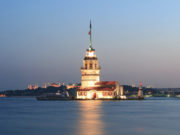
Two prominent examples of ancient Greek architecture are the Serpentine Column and Leander’s Tower.
Being approximately 2,500 years old, the Serpentine Column is said to be İstanbul’s oldest remaining Greek monument. Erected to honor the triumph of the Greeks over the Persians at Plataea, it originally stood at Delphi (both ancient cities on Greek ground) and was moved to İstanbul in 324 B.C. by Constantine the Great to mark the declaration of the new capital city of the then-founded Roman Empire under the name of Constantinople. The originally eight-meter-high piece was made up of three intertwined serpents which supported a golden bowl. The bowl is believed to have been lost or stolen when the city was sacked during the Fourth Crusade. Some say the heads were hit and cut off by a drunken nobleman in the 17th century but one of them can still be seen in the İstanbul Archaeology Museum. The rest of the column can be found today at the Hippodrome in the Sultanahmet quarter.
Surrounded by no fewer stories is Leander’s Tower, often referred to as Maiden’s Tower and located offshore in the Bosporus in the Üsküdar district. It was actually built in 408 B.C. by an Athenian general to control Persian ships sailing along the Bosporus. Another more well-known story is that of a sultan who erected the tower to protect his daughter from a snake bite, predicted by an oracle. But, as the story goes, there was no way to escape destiny: On the day of her 18th birthday, the sultan brought his daughter a basket of fruit as a gift and hiding within it, of course, was the predicted snake. The tower, which also contains a small, romantic restaurant, can be visited today by taking one of the small boats that sail from the nearby shore.
However, with the fall of Rome in 476, all that remained of the Roman Empire was its eastern part, which then came to be known as the Byzantine Empire. Distinctly Greek in culture and the center of Greek Orthodox Christianity, its capital, Constantinople, was adorned with many magnificent churches, including probably the most well known, Ayasofya (Hagia Sophia), once the world’s largest Christian cathedral.
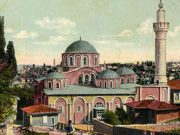
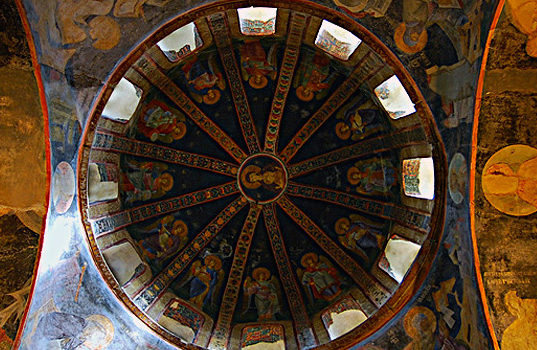
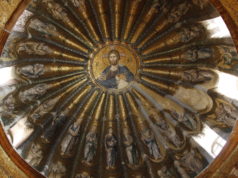
Other important churches that were built later on under Byzantine rule include the Pammakaristos Church, which is now Fethiye Mosque in the Çarşamba neighborhood of today’s Fatih district, and the Church of St. Savior in Chora, situated in the western Edirnekapı district of İstanbul and especially famous for its beautiful mosaics and paintings.
After the capture of the capital of the Byzantine Empire by the Ottoman Empire, under the command of Sultan Mehmed II (Mehmet the Conqueror) in 1453, naturally many city structures were destroyed. Mehmed’s main concern with İstanbul had to do with rebuilding the city’s defenses and re-population, and he soon devoted much energy to bringing prosperity to İstanbul. In 1459, he sent out orders that any Greeks — as well as Slavs, Jews and Armenians — who had left İstanbul as slaves or refugees and whose diverse skills were needed now to transform the city into a flourishing capital of the empire were allowed to return to the city.
Every third inhabitant in İstanbul was Greek
According to a census of 1477, there were 9,486 houses occupied by Muslims, 3,743 by Greeks, 1,647 by Jews, 267 by Christians from Crimea and 31 by Gypsies. Nearly every third inhabitant of the city was Greek at that time, so the Greek population played a significant role in the social, political and economic life of the city and the multiethnic, multi-religious Ottoman Empire in general. The leader of the Greek community within the empire officially became the ecumenical patriarch of the Greek Orthodox Church, which was moved to the Church of St. George in İstanbul’s Fener district in 1586. The patriarchate complex includes the authorization offices, the patriarchate library, the financial offices and the public enterprises of the patriarchate and the Cathedral Church of St. George. The church is definitely worth visiting. It is especially famous for its priceless artifacts and relics, which include the patriarchal throne, believed to date from the fifth century; three rare mosaic icons; a fragment of the Pillar of the Flagellation to which Jesus was tied and whipped; and the coffins of the three saints.
Further on, the Greek High School for boys on the top of Fener hill became an important educational institution to educate young Greeks for Ottoman bureaucracy and orthodox clergy as well. The Yoakimyon High School for girls and Marasli Greek Elementary School next to the patriarchate are other schools that can still be found in the district.
As you see, the list of Greek footprints in İstanbul seems endless. To start tracing them back, just take a small tour of Fener — you will come across an incredible number of smaller, more or less well-preserved churches, and you can still find a few of the typical, small Greek single-family houses, recognizable by their finely decorated facades.
Just take a look — it’s well worth it!
by Kristina Kamp
Start Slide Show with PicLens LiteThe Deisis, Supplication, Mother of God.
October 23, 2009 by Max Crandale
Filed under Articles
Walk through the door of the Chora Monastery Museum and you step back in time. One-thousand-four-hundred-seventy-three years, to be exact, when Chora was one the many beautiful churches that adorned Constantinople, the jewel in Byzantium’s crown.
When it was built, Chora was outside the Walls of Constantine, and so, today, is a bit off the beaten path — away from the long tourist magnets that are Hagia Sophia, the Blue Mosque, and Topkapi Palace.
“Chora,” in Greek, means “rural,” or “in the country,” and the monastery kept that name after it was incorporated within the enlarged Theodosian Walls.
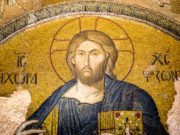
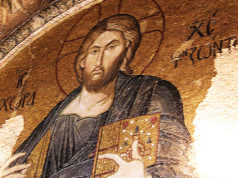
But the name “Chora,” also alludes to another, everlasting, realm: “I Chóra Ton Zónton,” The World of The Living,” proclaims an icon of Christ above the nave door. It’s one of the few mosaics that did not sustain damage during Fourth Crusade 1204 sack of Constantinople.
Evidence of this destruction — and that caused by the passage of 14 centuries — is seen in the bare walls and domes that once were filled with priceless mosaics.
Next to Christ Pantocrator.” (“He Who Holds All,” The Lord of the Universe.) That’s Theódoros Metochites, the man who restored Chora after the Latin invasion.
“Metochitis, a Byzantine poet, scientist, and minister of the treasury, kneels before the enthroned Christ, holding in his hands the restored Chora church.”
Icon of Christ of Chalke, the Bronze Gate of the Great Palace.
The greatest church in Christendom before St. Peter’s was constructed in Rome 1,000 years later, Hagia Sophia is the very symbol of Byzantium and occupies a special place in the Greek Orthodox heart.
But you don’t have to be Greek to appreciate its beauty and history — as Atatürk, the Father of modern Turkey, did in 1935 when he proclaimed Hagia Sophia a museum. Hagia Sophia’s Deisis (Supplication) mosaic, qualifies it as a World Heritage Site.
The Mother of God, a Chora dome mosaic.
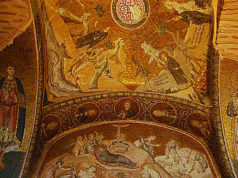
The virgin, clad in a blue chiton, reclines on a purple cushion by a cave housing the manger. The ox and the ass look on as divine light bathes the Child.
To the left of the cave appear angels, and to the right another angelic messenger gives the Good News to the shepherds residing in the fields.
The Nativity is just one of the beautiful scenes from the lives of Christ and the Virgin found in Chora. You could teach a whole Bible class just by walking around and pointing at the mosaics in this beautiful church: besides The Nativity, there are, The Presentation of the Virgin to the Temple, The Annunciation, The Flight into Egypt, The Miracle at Cana, Christ Healing the Leper, The Samaritan Woman at the Well, Christ Healing the Blind Man, Christ Healing the Paralytic, The Temptation of Christ, The Resurrection, treasures all.
The mosaic just below the dome of The Genealogy of Christ, a depiction of the Virgin Mary with Christ of the Chalke, especially moving. Named for an icon of Christ that hung above the Chalke, the “Bronze” Gate, the main ceremonial gate to the Great Palace. Reminiscent of the more famous Hagia Sophia Deisis Christ, this is the face of a benevolent God.

With Avar armies at the gates, those prayers were answered, and Patriarch and people gathered in Hagia Sophia to offer thanksgiving to the Mother of God for The City’s deliverance. (The City, I Polis, as Constantinople was known, is found in the name of Turkey’s largest city and artistic and cultural capital: Is Tin Polin, To The City — Istanbul.)
In thanksgiving was written a beautiful long hymn, Ti Ypermáho, “To the Invincible General.” After a millenium-and-a-half it is still being sung in Orthodox churches for five consecutive Friday evenings before Easter Sunday. An Orthodx hymn that accompanies our Chora video, who’s beloved melody is dear to my soul. Hearing it now brings back Constantinople’s fateful history and The City’s special place in the Greek psyche. A hymn that I find myself humming in front of the Chora mosaic icon of the Mother of God:
Ti Ypermáho Stragigó ta nikitíria,
Os lytrothisa ton dinón efharistíria,
Anagráfo Soi i Pólis sou Theotóke.
All’ os éhousa to krátos aprosmáhiton,
Ek pantíon me kindínon elefthéroson.
Ína krázo soi; Hére Nífi Anímfefte.
“To Thee, Invincible General, I ascribe the victory/Having been delivered from suffering, Your City offers thanksgiving/to You O Mother of God./And having your might unassailable/Free us from all dangers/So we may cry unto you/Hail O Bride Unwedded.”
In the end, there could be no deliverance — 5,000 defenders besieged by 350,000 Ottomans — The City — and Byzantium — fell.
Start Slide Show with PicLens LiteChora Church Museum
September 15, 2009 by Max Crandale
Filed under Articles
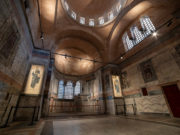
The building, known today known as the Kariye (Chora) Museum, was built on the site of the Chora Monastery. “Chora” means “outside the city” or “countryside” in Ancient Greek. The Roman city walls were erected before the 5th century and show us that the monastery was built earlier than that. This name was preserved for churches that were built on this site, and the last church, which dates from the l1th to 14th century, constituted the base of the present-day museum.
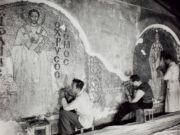
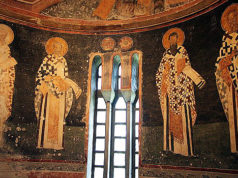
The building was decorated with magnificent mosaics and frescoes, which are considered to be masterpieces of Byzantine art. it was built by Theodore Metochites, who was a leading statesman and scholar of his day. In the mosaics of the two narthexes located at the entrance, the Iives of the Virgin Maryand Jesus Christ, as told in the Bible, are illustrated in chronological order. In the lateral chapel, religious subjects are depicted in frescaes. In these frescoes, you can also see the figures of notable personalities from the Church and the Palace. The mosaics and frescaes, which, were discovered and restored, in the 1950s, are the works of a group of prominent artists.
The mosaics that were located on the upper side of the centralnarthex do not exist today. it was one of the features of Byzantine art to add monograms and inscription next to the figures. The Kariye museum is located in a beautiful district fall of wooden hotel (Kariye Otel) and cafes (Asitane Restaurant).